
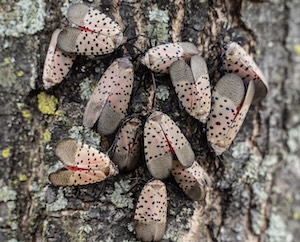
 The spotted lanternfly (SLF) is an invasive insect that causes damage to trees and other woody plants by feeing on their sap, first found in the United States in 2014. While the primary host plant of SLF is the tree-of-heaven, which is also an invasive species, it also targets maples, black walnuts, grape vines, hops, fruit trees, and over 100 other trees, shrubs and vines.. As a result the spotted lanternfly has the potential to cause serious damage to a broad range of agricultural commodities and trees statewide.
The first known infestation of SLF in Massachusetts was in 2021. In Shrewsbury, they started appearing in 2025, especially near trucking routes. This year, 2026, Shrewsbury has been hit hard, particularly near Lake Quinsigamond, where residents are seeing trees in their yards become infested, blacken, and die. Spotted Lanternflies do not fly well, but they hitch rides on cars and trucks, which is how they have spread from Pennsylvania to Ohio and all of New England. That is primarily how they are spreading through Shrewsbury, and how they will spread to surrounding towns.
Spotted lanternfly adults and nymphs cause significant damage by feeding on sap from the stems and leaves of host plants, as well as the trunks of the trees. Adult lanternflies also damage plants by feeding on the sap and excreting honeydew. The honeydew, which sprays down from infested plants, causes sooty mold and attracts other insects that may also cause damage to the plant.
Eggs are laid on any flat surface as a mass and have the appearance of mud. During their nymph stages they change from black with white speckling to red black and white in the final nymph stage. Adults have brownish-gray forewings with black spots, and appear dull when at rest. When in flight bright red and white hindwings are viable.
There are ways we can manage spotted lanternflies, but it will take lots of us pitching in. To begin with, we need to get as close as we can to eradicating tree-of-heaven. This will be difficult because it is invasive and widespread throughout town. The worst way to try to eradicate it is to cut it down. The wide-spreading roots will send up multiple shoots like the hydra in Greek mythology, which, when one head was severed, grew back two more in its place.
Tipping Point 01545 is planning a presentation at the Shrewsbury Public Library. Keep your eyes open! This is not one to miss!
In addition, the Mass. Dept. of Agricultural Resources is hosting quarterly updates with more information about the spotted lanternfly and local impacts. The next webinar is on November 4, 2026: Spotted lanternfly in Massachusetts: Quarterly Update, November 2026
Sources: